Development fee
A fee for taking a project from a water area to a delivered community. Indicatively 3–8% depending on DONSÖ's role and the scope of the project.
Business Model
DONSÖ is a platform and IP company. It earns from designing, coordinating and standardizing floating residential communities — not from owning every home. The guiding principle is simple: demand before capacity, projects before factories.
Revenue model
One standardized system creates several ways to earn across development, delivery and operation. These describe the business model and its future potential — they are not revenue that has been contracted.
A fee for taking a project from a water area to a delivered community. Indicatively 3–8% depending on DONSÖ's role and the scope of the project.
A margin on the home modules and produced system components, captured through DONSÖ's control of the design and specifications.
A system, IP or licence fee per installed home, for the standardized architecture, design rules and compliance pathway.
Energy, water and wastewater, decks, mooring, access and the technical interfaces that turn berthed homes into a community.
Inspection, maintenance, monitoring and component replacement over the long life of the asset.
Metering, solar, batteries, charging and possible local energy management across the community.
Over the longer term, minority investment or co-investment in selected project companies.
Path to scale
Each phase is reached only when the previous one has been proven. Capacity follows demand.
The engineered system definition: marine engineering, buoyancy and stability, mooring, fire strategy, energy, water and wastewater, materials and durability, manufacturing design, regulatory classification, and insurance and lender requirements.
One full-scale home that works as a technical demonstrator, a showroom, a test environment, temporary accommodation for visiting partners, the basis for supplier quotations, and the anchor for authority and financing dialogue.
The first community: 50 homes targeted for price-accessible owner-occupation, delivered with project-level capital in the Gothenburg Harbour Region.
Repeatable demand from municipalities and ports, property developers, housing companies, student-housing operators, staff-housing operators, and hospitality and resort operators.
Initial replication markets under consideration: Gothenburg, Stockholm, Copenhagen, Amsterdam, Hamburg and Helsinki. These are candidate markets, not an existing pipeline or ongoing negotiations.
Production capacity is established only once there is a validated product, a verified production cost, a full-scale demonstrator, qualified projects, conditional customer commitments and a financeable order book.
Manufacturing strategy
DONSÖ is designed to scale through existing industrial capacity before committing capital to a dedicated factory. Modules and sub-systems are built by established manufacturers working to DONSÖ's specifications.
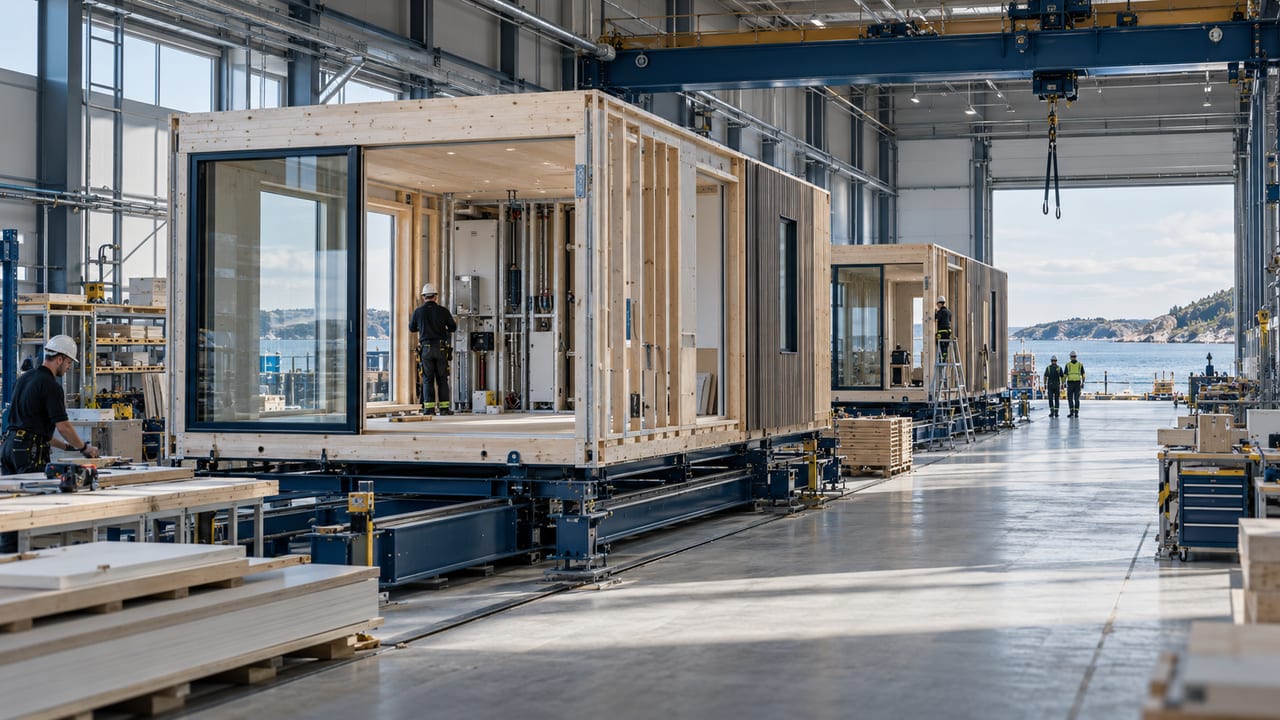
The system IP, design rules, engineering interfaces, coordination of third-party certification, production specifications, projects, customers, data and brand. When volume and order book justify it, DONSÖ can establish owned or jointly-owned automated capacity.